Why Ranking #1 on Google Doesn't Guarantee AI Visibility
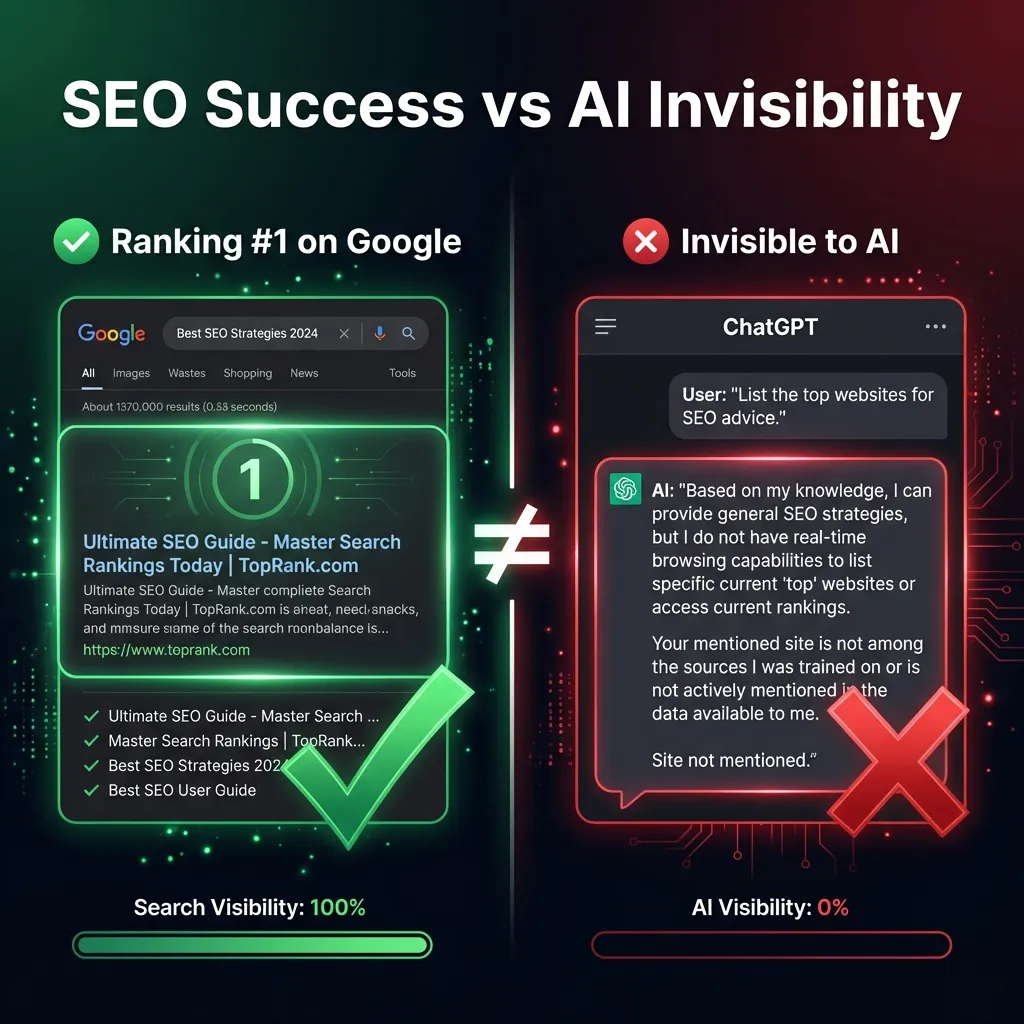
Ranking #1 on Google does not mean AI systems like ChatGPT or Google AI Overviews will mention your website. SEO and GEO optimize for different systems with different requirements.
Ranking #1 on Google does not mean AI systems like ChatGPT or Google AI Overviews will mention your website. SEO and GEO optimize for different systems with different requirements.
A website can dominate search rankings and still be invisible to AI answer engines.
Want the quick comparison? Jump to the SEO vs GEO table →
Key Takeaway
SEO optimizes for search engine rankings. GEO (Generative Engine Optimization) optimizes for AI-generated answers. High rankings don't guarantee AI citations because AI evaluates content differently than search engines.
What SEO Optimizes For
Traditional Search Engine Optimization focuses on ranking higher in search results. It's been the standard for 25+ years.
SEO success factors:
- Keywords: Matching user search queries
- Backlinks: External sites linking to you
- Technical SEO: Site speed, mobile-friendliness, crawlability
- Content length: Comprehensive coverage of topics
- User signals: Click-through rate, time on page
- Meta optimization: Title tags, meta descriptions
These factors help Google rank pages in search results. But AI systems evaluate content differently.
What GEO Optimizes For
Generative Engine Optimization (GEO) focuses on getting cited in AI-generated answers. It's a newer discipline emerging with the rise of AI assistants.
GEO success factors:
- Clarity: Clear, quotable statements AI can extract
- Structure: Proper heading hierarchy and document organization
- Trust signals: Author info, dates, sources, About page
- Direct answers: Questions answered in the first 50 words
- Entity consistency: Same product name and description everywhere
- Visible pricing: No hidden "contact sales" pricing
These factors help AI systems understand, trust, and safely cite your content.
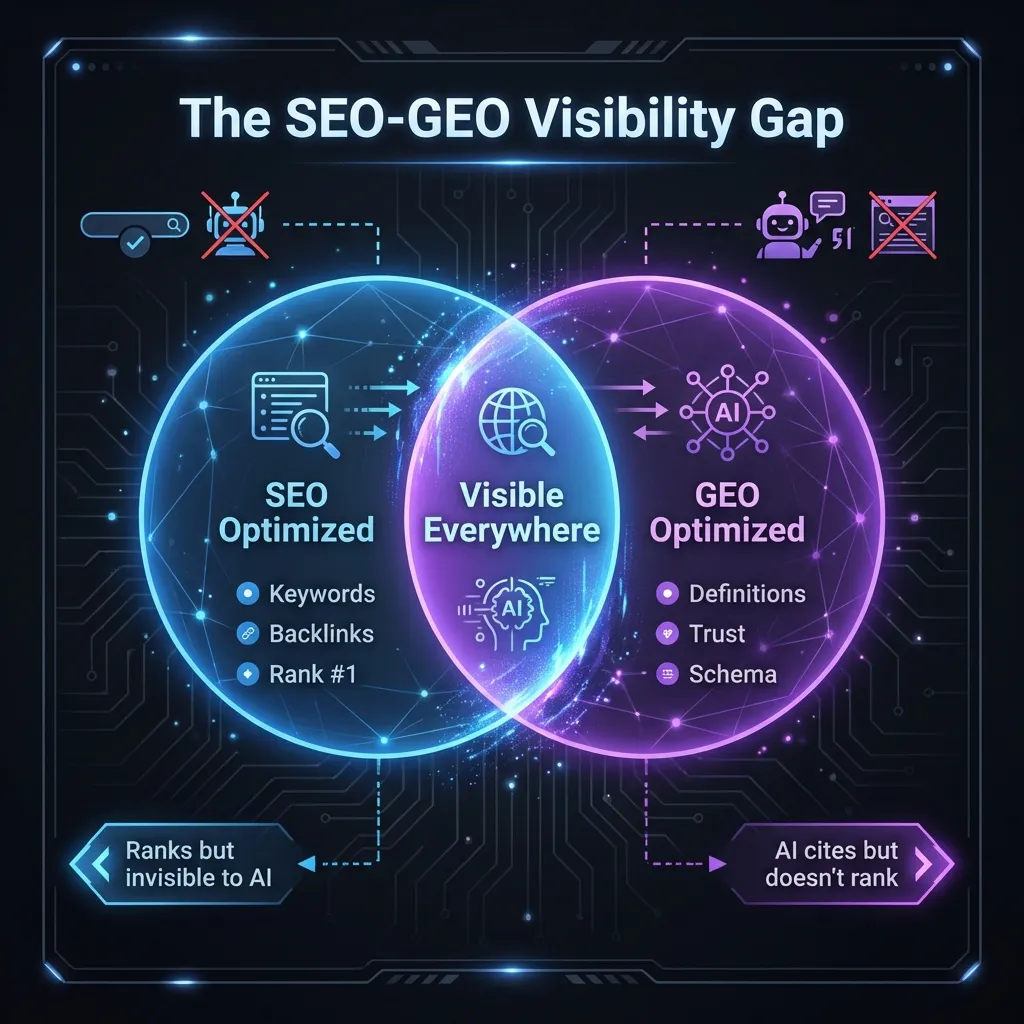
SEO vs GEO: Complete Comparison
This table shows the key differences between SEO and GEO optimization:
| Aspect | SEO | GEO |
|---|---|---|
| Full name | Search Engine Optimization | Generative Engine Optimization |
| Goal | Rank higher in search results | Get cited in AI-generated answers |
| Target system | Google, Bing (search engines) | ChatGPT, Perplexity, AI Overviews |
| How ranking works | Keywords, backlinks, technical factors | Structure, clarity, trust signals |
| Success metric | Position 1-10 on Google | Mentioned/cited by AI |
| Content style | Keyword-optimized | AI-quotable facts |
| Link importance | Critical (authority signal) | Less important than content quality |
| Time to results | Months | Can be immediate |
| Works together? | Yes | Yes |
Why High Rankings Fail in AI
A page optimized for SEO can fail for AI citations for several reasons:
1. Keyword-stuffed content
SEO content often repeats keywords unnaturally. AI needs natural, quotable language it can extract cleanly.
2. Long-form without structure
SEO rewards comprehensive content. But AI needs clear headings and short paragraphs to extract information.
3. Marketing language
SEO content often includes persuasive marketing copy. AI cannot quote "best-in-class" or "revolutionary" as facts.
4. Buried answers
SEO content may delay the answer to increase time on page. AI needs the answer in the first 50 words.
5. Missing trust signals
SEO doesn't require author names or dates. AI needs these trust signals before citing content.
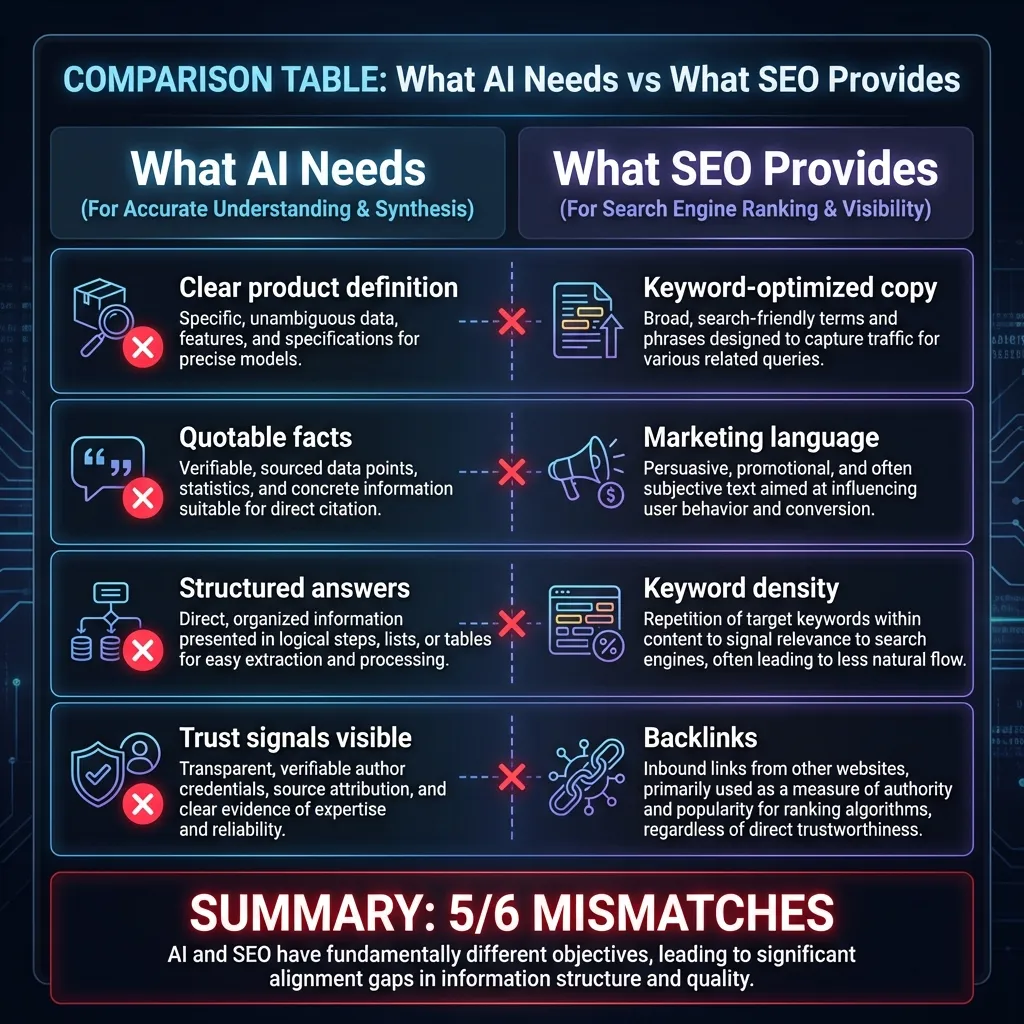
Examples of SEO Success / GEO Failure
Example 1: SaaS Homepage
SEO-optimized (ranks #1)
"The #1 project management software trusted by millions. Experience the future of team collaboration with our award-winning platform..."
GEO-optimized (gets cited)
"Acme is a project management tool for remote teams. It includes task tracking, time logging, and team chat. Pricing starts at $10/month."
Example 2: Pricing Page
SEO approach
"Contact our sales team for custom enterprise pricing tailored to your needs..."
GEO approach
"Free: $0/mo (5 users). Pro: $29/mo (unlimited users). Enterprise: $99/mo (priority support)."
How to Optimize for Both
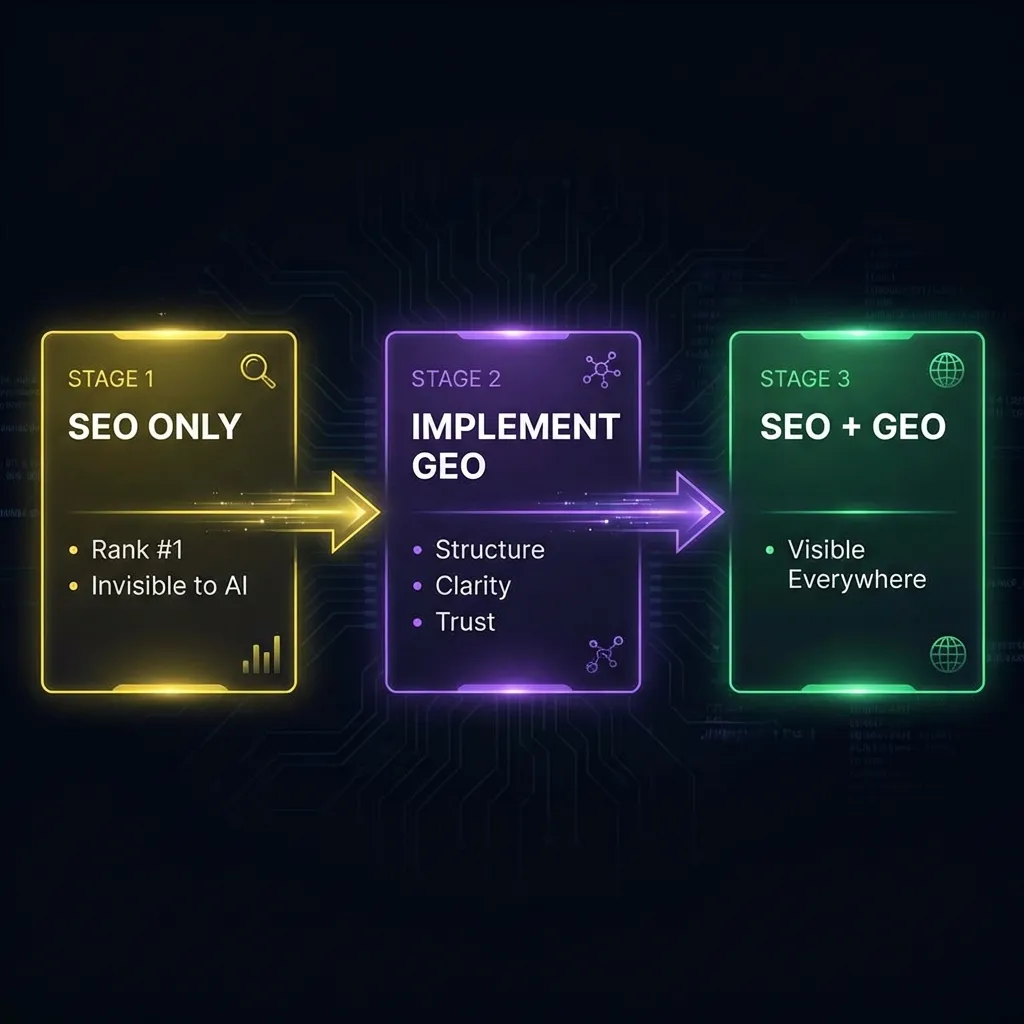
The good news: you can optimize for both SEO and GEO. Here's how:
- 1
Lead with GEO-friendly content
Put clear answers in the first 50 words. AI will cite this; users will appreciate directness.
- 2
Follow with SEO depth
Expand with comprehensive coverage for search engines after the direct answer.
- 3
Structure for both
Use headings that work for humans, search engines, and AI extraction.
- 4
Track both metrics
Monitor search rankings AND test AI citations regularly.
Sources and Further Reading
This article is based on research and official documentation:
- Google: SEO Starter Guide — Official Google documentation on search engine optimization
- Google: AI in Search — How AI is changing search results and citations
- OpenAI: ChatGPT Browsing — How ChatGPT accesses and processes web content
Frequently Asked Questions
Yes. Google and AI systems evaluate content differently. A page can rank #1 for keywords but lack the structure, clarity, and trust signals AI needs to safely cite it.
Both matter. SEO drives search traffic, while GEO drives AI citations. The good news is that many optimizations help both. Start with GEO-friendly structure, then layer on SEO elements.
No. Google AI Overviews select sources based on clarity and extractability, not just rankings. A page can rank lower but appear in AI Overviews because it provides a clearer answer.
No. SEO and GEO serve different purposes. SEO will continue to matter for search rankings. GEO is an additional optimization layer for AI-generated answers. Both will coexist.
Test it by asking AI systems direct questions about your content. If AI gives wrong answers, ignores you, or cites competitors, your content needs GEO optimization.
Indirectly. Backlinks signal authority, which AI may consider. But AI primarily evaluates content quality, structure, and clarity—not link counts.
Related Resources
Your Site Passes Every SEO Audit. AI Still Ignores It.
83% of pages ChatGPT retrieves aren't in Google's SERPs. The 5 dimensions SEO misses.
Read more3 Things to Fix Before AI Will Ever Cite Your Page
The three most common blockers and how to fix each one
Read moreHow to Get Your Website Mentioned by ChatGPT
Step-by-step GEO guide
Read more