Why ChatGPT Doesn't Mention Your Website
ChatGPT does not mention most websites because pages lack clear structure, product definitions, and trust signals. AI systems avoid citing content that could cause hallucinations or provide incorrect information.
ChatGPT often doesn't mention specific websites because pages lack clear structure, product definitions, and trust signals. AI systems avoid citing content that could cause hallucinations or provide incorrect information to users.
This is not a traffic problem. Your site can receive thousands of visitors and still be invisible to AI answer engines. The issue is how your content is structured, not how popular it is.
Key Takeaway
ChatGPT ignores websites that lack clear definitions, trust signals, and structured content. Fixing these issues requires GEO (Generative Engine Optimization), not traditional SEO.
⚡ Quick Fixes (Do Today)
- Add product definition in first 50 words of homepage
- Show pricing (not "contact sales")
- Add published date to all content
- Create one comparison page
- Add About page with real names
Want to check your own site? Skip to the diagnostic checklist →
How AI Systems Select Sources
Many AI assistants don't browse the web by default. They are trained on datasets and may retrieve information from external sources during inference. Even when they do retrieve content, they prefer sources that are structured, consistent, and trustworthy.
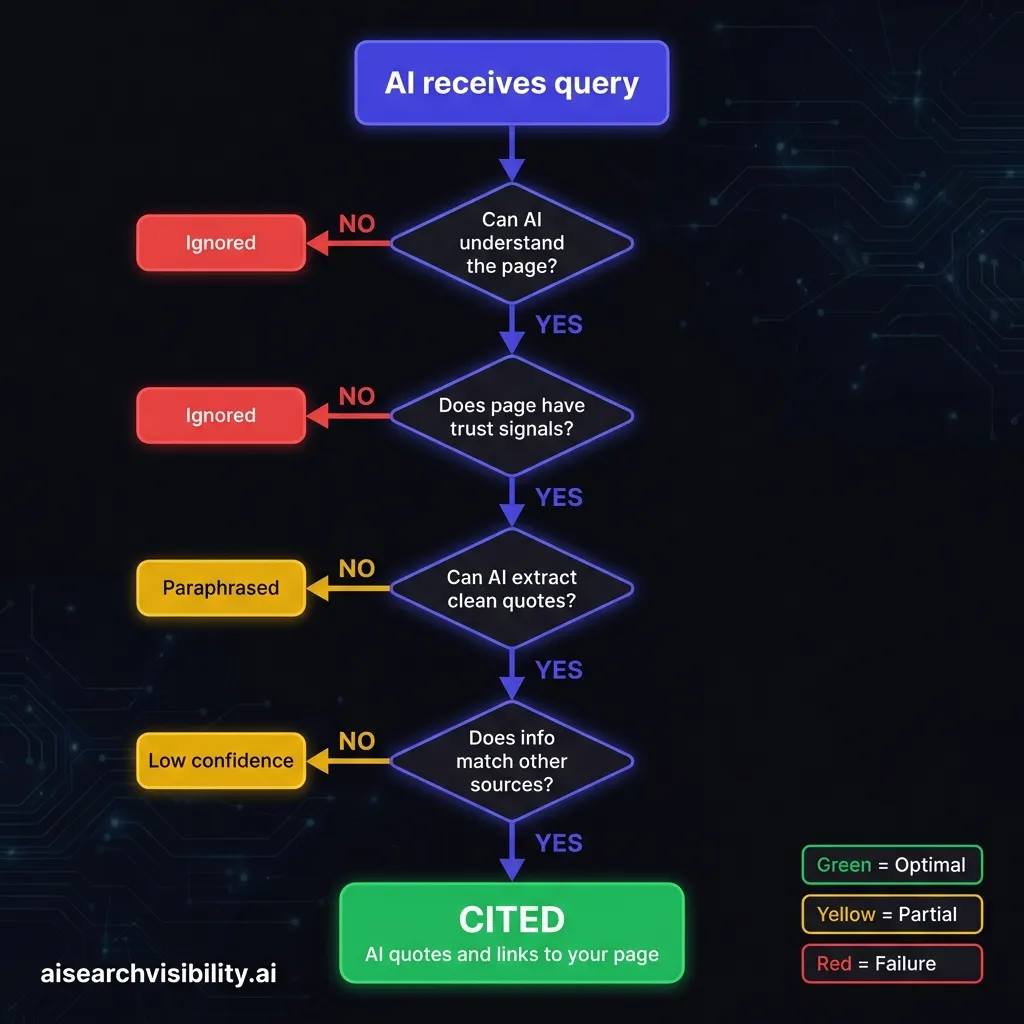
When an AI generates a response, it evaluates potential sources based on:
- Clarity:Can the AI understand what the page is about?
- Trust:Does the page have signals that make it safe to cite?
- Extractability:Can the AI pull a clean, accurate quote?
- Consistency:Does the information match other trusted sources?
If your page fails any of these criteria, AI will either ignore it or generate information without citing you—even if your content would be helpful.
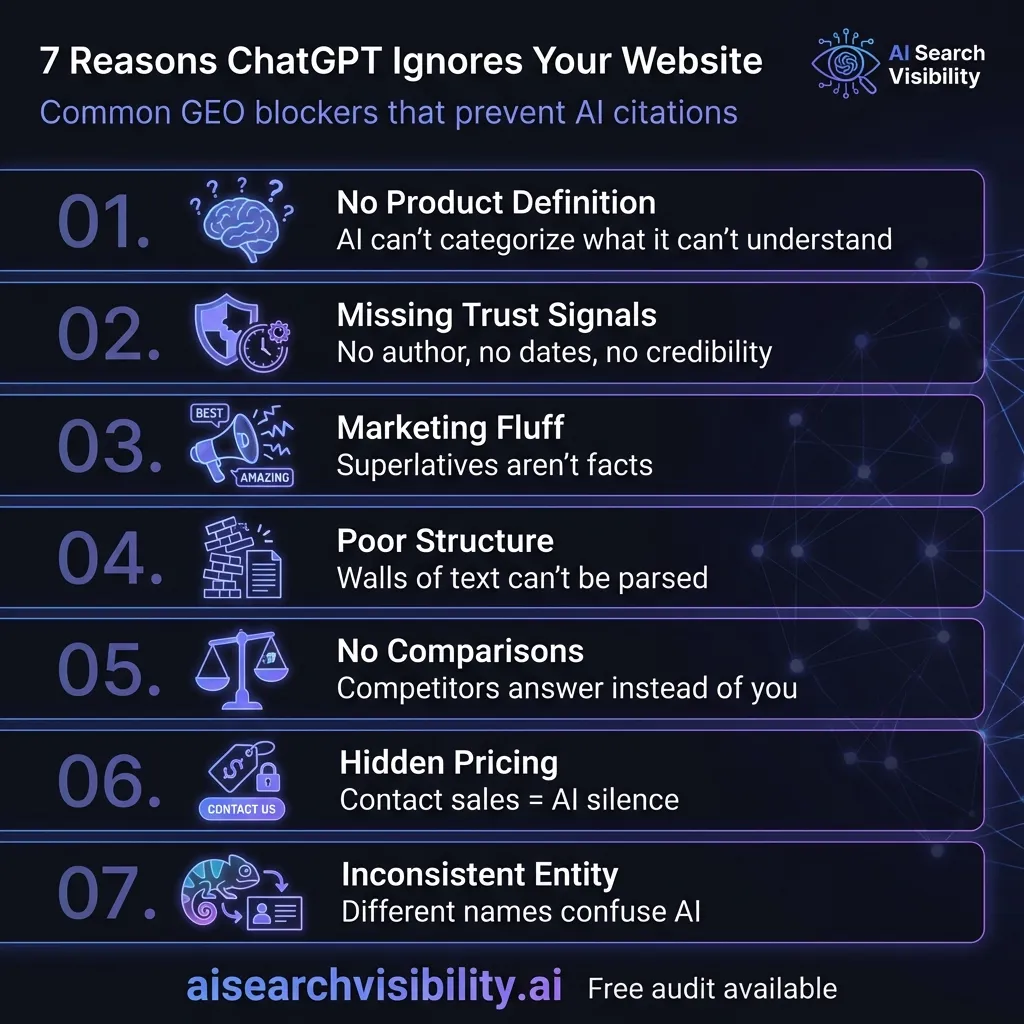
7 Reasons ChatGPT Ignores Your Website
These are the most common reasons AI systems do not mention websites in generated answers. Based on patterns observed across multiple AI systems—though behavior varies by model and version.
1. No Clear Product Definition
AI needs to understand what your product IS before it can recommend it. If your homepage uses vague language like "the future of productivity" instead of "a project management tool for remote teams," AI cannot categorize or recommend you.
Bad Example
"Welcome to the future of work. Our revolutionary platform helps teams achieve more."
Good Example
"Acme is a project management tool for remote teams. It includes task tracking, time logging, and team chat. Pricing starts at $10/month."
The good example can be quoted directly. The bad example cannot.
2. Missing Trust Signals
AI systems evaluate whether a source is trustworthy before citing it. Trust signals include:
- Author names and credentials
- Company information (About page, team, location)
- Published and updated dates
- External validation (reviews, press mentions, backlinks)
- Privacy policy and terms of service
If your website is anonymous or lacks these signals, AI systems will avoid citing it to prevent recommending untrustworthy sources.
3. Marketing Fluff Instead of Facts
AI cannot quote marketing language. Phrases like "best-in-class," "revolutionary," and "world-leading" provide no factual information.
Bad Example
"Our cutting-edge, AI-powered solution delivers unprecedented results for forward-thinking teams."
Good Example
"This tool uses GPT-4 to generate email drafts. It costs $29/month and includes a free tier with 50 emails."
Facts can be cited. Marketing fluff cannot.
4. Poor Content Structure
AI parses content using heading hierarchy and page structure. If your page is a wall of text with no headings, or if your headings don't describe the content beneath them, AI cannot extract information reliably.
Requirements for AI-readable structure:
- One H1 per page (describes the main topic)
- H2s for major sections
- H3s for subsections
- Short paragraphs (2-3 sentences)
- Bullet points for lists
- Tables for comparisons
5. No Comparison Content
When users ask AI "What's the best [category]?" or "[Product A] vs [Product B]?", AI looks for comparison content to answer.
If you have no comparison pages, AI will use your competitors' comparison pages instead—and they may not present your product favorably.
Required comparison content:
- [Your Product] vs [Competitor 1]
- [Your Product] vs [Competitor 2]
- Best [Category] tools (with your product included)
- [Competitor] alternatives
6. Hidden or Missing Pricing
"Contact sales for pricing" is a GEO failure. AI cannot recommend your product if it doesn't know what it costs.
Users frequently ask AI questions like:
- "How much does [Product] cost?"
- "What's the cheapest [category] tool?"
- "Is [Product] free?"
If your pricing isn't visible on your website, AI cannot answer these questions accurately—and may recommend competitors instead.
7. Inconsistent Entity Information
AI builds an understanding of your product as an "entity." If your product name, description, or category varies across pages, AI becomes confused about what you are.
Common inconsistencies:
- Product name spelled differently (Acme, ACME, acme.io)
- Different category descriptions ("CRM," "sales tool," "customer platform")
- Conflicting information across pages
Use the same product name, category, and description on every page.
Why Google Rankings Don't Guarantee AI Visibility
Ranking #1 on Google does not mean AI will mention your website. SEO and GEO optimize for different systems with different requirements.
| Factor | SEO (Search Engines) | GEO (AI Engines) |
|---|---|---|
| Goal | Rank higher in search results | Get cited in AI-generated answers |
| How it works | Keywords, backlinks, technical factors | Structure, clarity, trust signals |
| Success metric | Position 1-10 on Google | Mentioned by ChatGPT, Perplexity |
| What matters most | Link authority | Content extractability |
| Time to results | Months | Varies—some changes can have immediate impact |
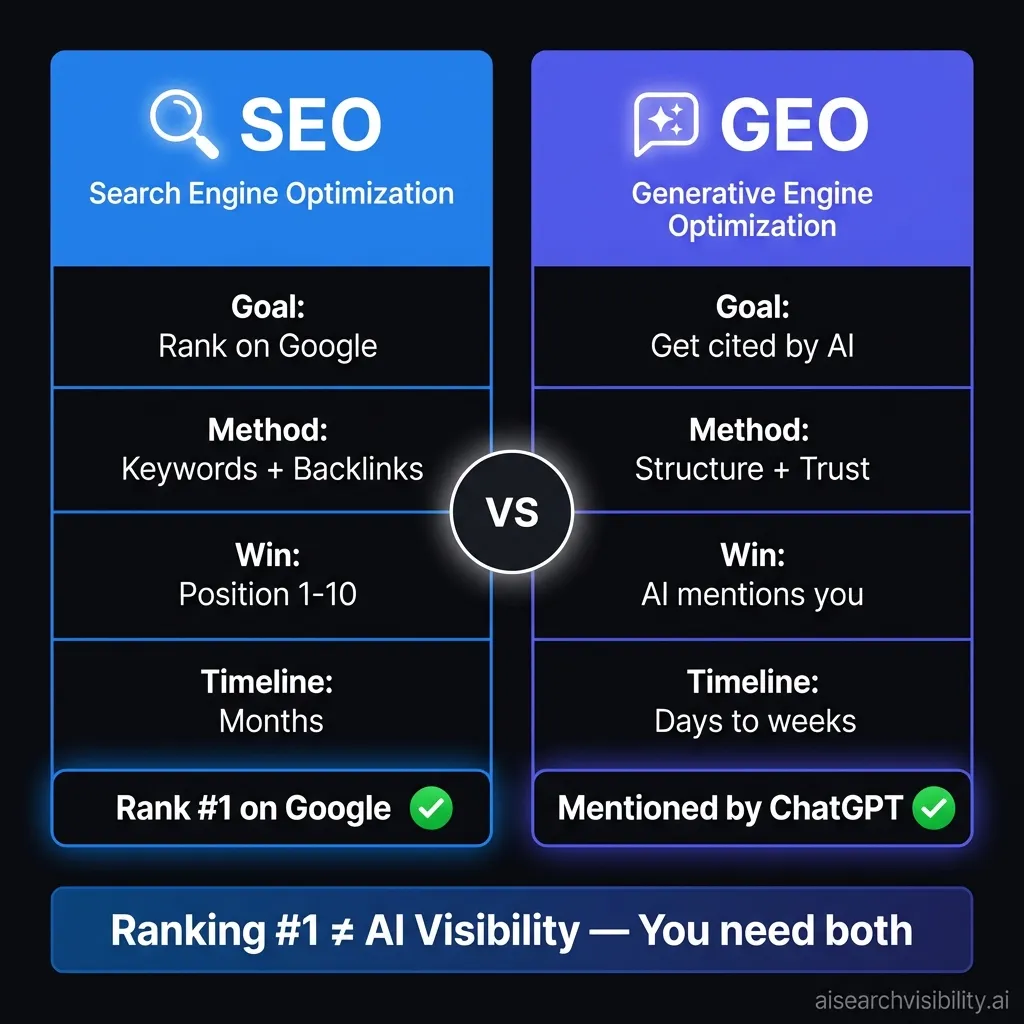
A page optimized for SEO may use keyword-rich language that sounds unnatural when quoted by AI. A page optimized for GEO uses clear, factual language that AI can safely cite.
Both matter, but they require different optimization approaches.
Learn more: Why Ranking #1 Doesn't Guarantee AI Visibility →
What AI-Quotable Content Looks Like
Here are two examples of content that AI systems can safely extract and cite. Notice the specific facts, clear structure, and absence of marketing language.
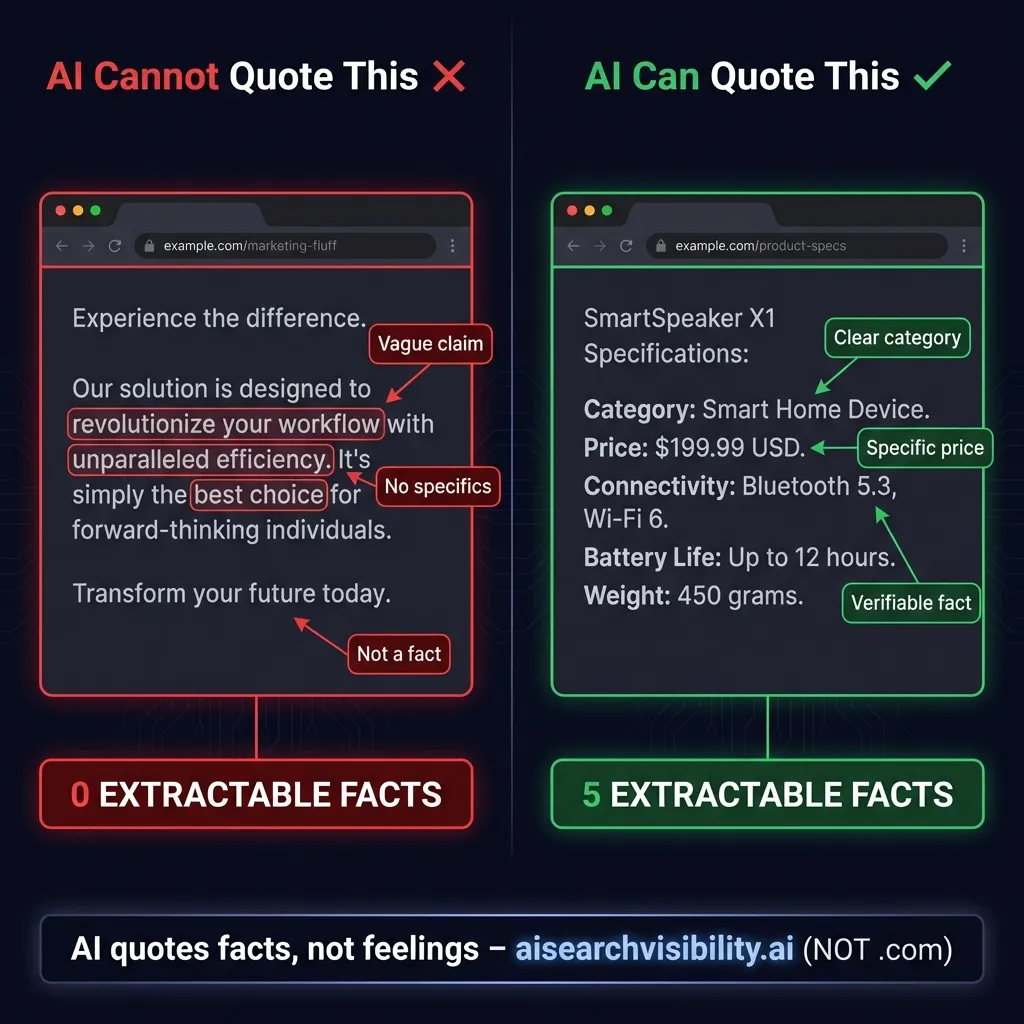
Example 1: Product Definition
"Notion is a connected workspace that combines notes, docs, wikis, and project management. It offers a free plan for individuals, with paid plans starting at $8/user/month for teams. Founded in 2013, Notion is headquartered in San Francisco and has over 30 million users."
Why it works: Clear category, specific pricing, verifiable facts, no superlatives.
Example 2: Feature Comparison
| Feature | Slack | Discord | Teams |
|---|---|---|---|
| Free tier | 90 days history | Unlimited | Limited |
| Paid from | $7.25/user/mo | $2.99/mo | $4/user/mo |
| Best for | Business teams | Communities | Microsoft orgs |
Why it works: Structured data, specific numbers, easy to extract any cell.
Quick Wins: Do This First
Start with these high-impact, low-effort fixes before moving to larger structural changes:
Add a one-sentence product definition
Put it in the first 50 words of your homepage. Example: "[Product] is a [category] that helps [audience] do [thing]."
Show all pricing on your pricing page
No "contact sales" for standard plans. AI needs specific numbers to cite.
Create one comparison page
Start with your top competitor: "[Your Product] vs [Competitor]."
Add an About page with team info
Include real names, roles, and credentials. Anonymous websites get ignored.
Include published/updated dates on all content
AI trusts dated content more than undated content.
Check Your AI Visibility
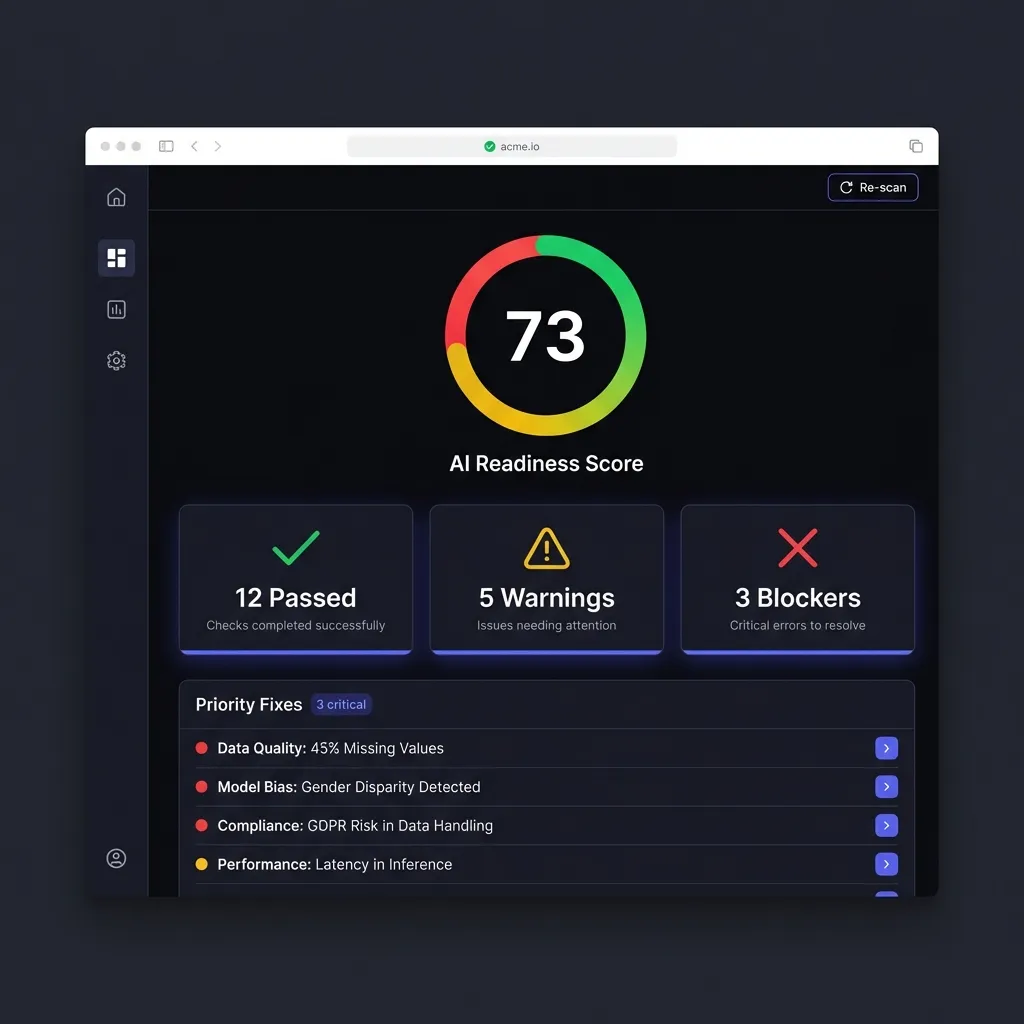
Use this checklist to diagnose your own pages, or let our tool score them automatically.
Quick Self-Check
AI Search Visibility automates this audit. It's a GEO (Generative Engine Optimization) tool that analyzes whether AI systems can understand, trust, and correctly cite your website.
Input:
- • Your homepage URL
- • Pricing page (if applicable)
- • Up to 3 additional key pages
Output:
- • AI Readiness Score (0-100)
- • Prioritized blocker list
- • Copy-ready fix recommendations
Status: Currently in development. Join the waitlist for early access and a free audit when we launch.
How We Know This Works
This guide is based on observed patterns across multiple AI systems and published research:
- GEO: Generative Engine Optimization — Princeton/Georgia Tech research on optimizing for AI answer engines
- Google's Helpful Content Guidelines — E-E-A-T signals that AI systems use to evaluate trustworthiness
- Schema.org Documentation — Structured data standards for machine-readable content
- Perplexity AI Documentation — How retrieval-augmented AI selects and cites sources
Note: AI system behavior varies by model, version, and retrieval settings. These recommendations reflect patterns observed across multiple systems, not guarantees for any specific AI. No tool can guarantee AI citations.
Check Your AI Visibility
AI Search Visibility is launching soon. Join the waitlist to get early access and a free audit when we launch.
Frequently Asked Questions
ChatGPT often doesn't mention specific websites because they lack clear structure, trust signals, and quotable content. AI systems tend to avoid citing sources that could cause hallucinations or provide incorrect information.
Not directly. Strong SEO can help discovery, but AI citations depend more on extractable facts, clear definitions, and trust signals than on search rankings. A website can rank #1 on Google and still be ignored by AI systems.
To increase the likelihood of ChatGPT recommending your product, you need clear product definitions, visible pricing, comparison content, and trust signals. This is called GEO (Generative Engine Optimization). Note: No tool can guarantee AI citations.
Trust signals include: author names and credentials, About page with team information, published and updated dates, reviews and testimonials, privacy policy, and consistent entity information across pages.
Some fixes can have immediate impact on retrieval-based AI systems. Structural changes like adding pricing, clear definitions, and trust signals can be implemented in days. Building authority and comparison content takes weeks to months. Results vary by AI system and are not guaranteed.
Yes. AI Search Visibility is a GEO audit tool that analyzes whether AI systems can understand, trust, and cite your website. It provides specific recommendations for improvement. The tool is currently in development with early access available via waitlist.
Related Resources
3 Things to Fix Before AI Will Ever Cite Your Page
The three most common blockers and how to fix each one with before/after examples
Read moreYou Blocked ChatGPT and Didn't Even Know It
5.89% of sites block GPTBot accidentally. Here's how to check in 10 seconds.
Read moreHow to Get Your Website Mentioned by ChatGPT
Step-by-step guide to improving AI visibility
Read more