Google AI Overviews SEO - How to Get Featured
Google AI Overviews are AI-generated summaries that appear at the top of search results. To get featured, your content must be structured for AI extraction, not just traditional SEO.
Google AI Overviews are AI-generated summaries that appear at the top of search results. To get featured, your content must be structured for AI extraction, not just traditional SEO.
This requires optimizing for clarity, direct answers, and trust signals—the same principles as GEO (Generative Engine Optimization).
Key Takeaway
AI Overviews select sources based on content clarity and extractability, not just search rankings. A page with clear, direct answers in a structured format has better chances of appearing than a keyword-optimized page without clear answers.
⚡ Quick Wins (Do Today)
- Put your direct answer in the first 50 words
- Add author name + published date to all content
- Use one H1, then H2s for major sections
- Add FAQPage schema to Q&A sections
- Link to authoritative sources for claims
Ready to optimize your content? Skip to the optimization checklist →
What Are Google AI Overviews?
Google AI Overviews are AI-generated answer boxes that appear at the top of certain search results. They synthesize information from multiple web sources to provide direct answers.
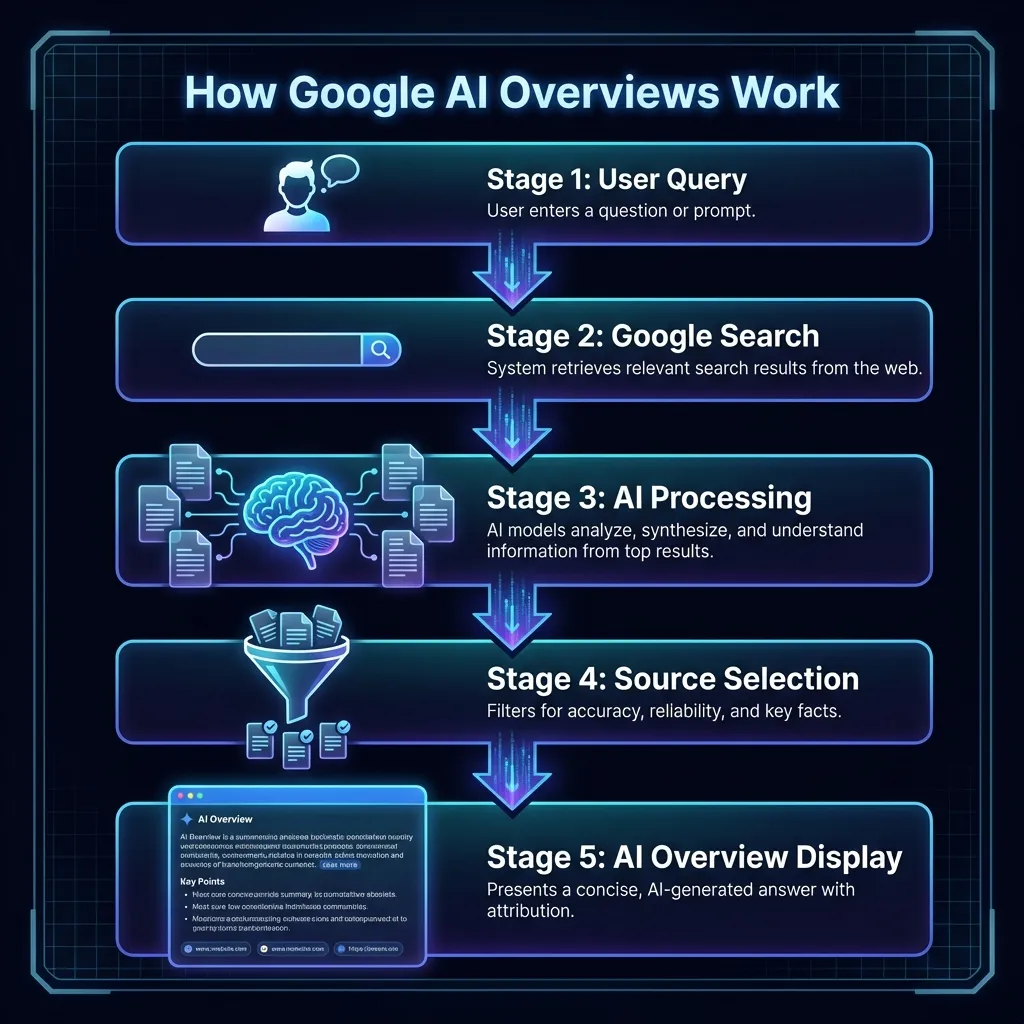
Key characteristics:
- Appear above traditional search results
- Synthesize information from multiple sources
- Include citations to source pages
- Triggered by informational queries
- Generated by Google's AI models
Unlike featured snippets (which extract existing text), AI Overviews generate new text that synthesizes information from multiple sources.
How Google Selects Sources for AI Overviews
Google's AI evaluates potential sources based on several factors:
1. Content Clarity
The page must clearly answer the user's question. Ambiguous or vague content is skipped.
2. Extractability
AI must be able to extract clean quotes without risking misrepresentation. Well-structured content with clear headings helps.
3. Authority Signals
Content from authoritative sources with clear authorship, dates, and expertise signals is preferred.
4. Factual Accuracy
Information must be verifiable and consistent with other trusted sources. Contradicting established facts leads to exclusion.
5. Freshness
For time-sensitive queries, recently updated content is preferred. Include visible publish and update dates.
Content Types That Appear in AI Overviews
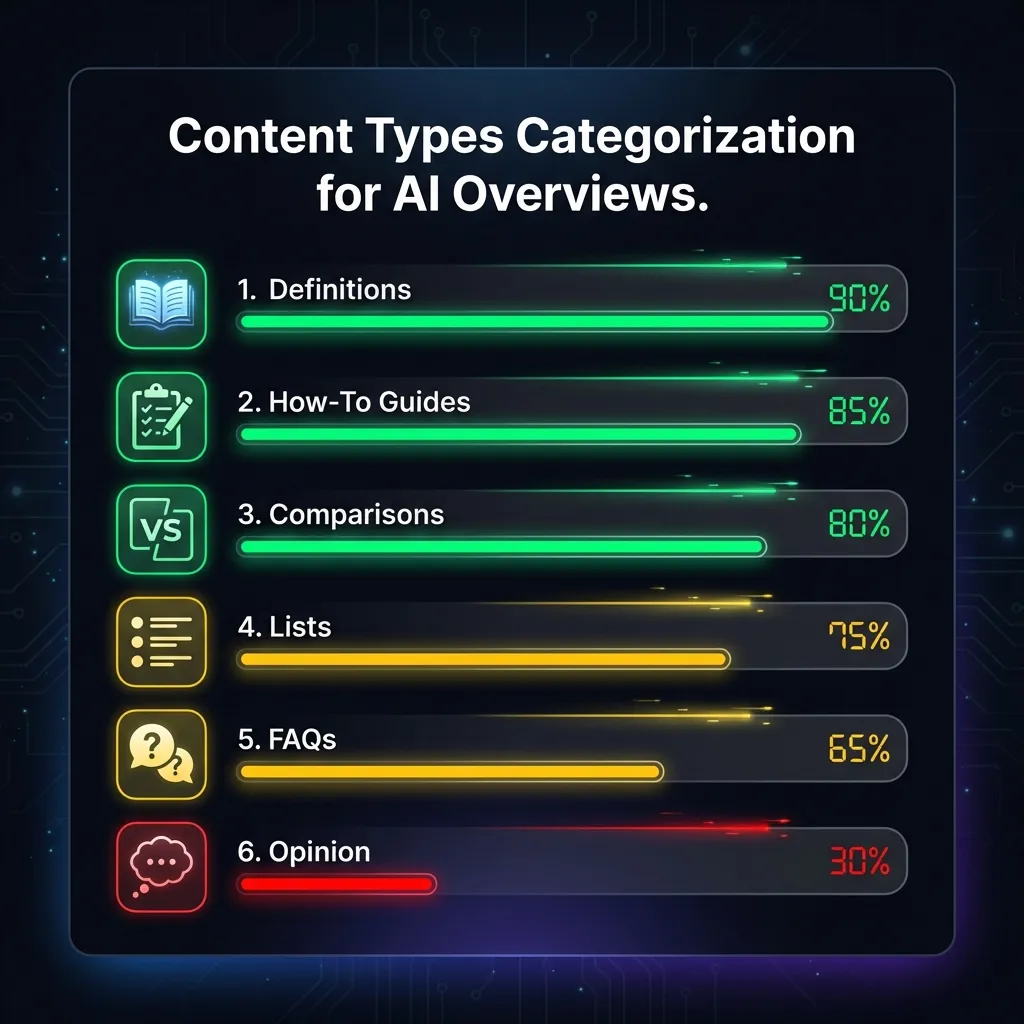
Certain content types are more likely to be selected for AI Overviews:
| Content Type | Likelihood | Why |
|---|---|---|
| Direct answers | High | AI can extract clean quotes |
| Definitions | High | Factual, quotable |
| Step-by-step guides | High | Clear structure |
| Comparison tables | Medium-High | Easy to extract |
| Statistics with sources | Medium-High | Verifiable facts |
| Expert explanations | Medium | Authoritative |
| Opinion content | Low | Hard to verify |
| Marketing copy | Very Low | Not quotable |
Content Types That Rarely Appear
Some content types are very unlikely to be selected for AI Overviews:
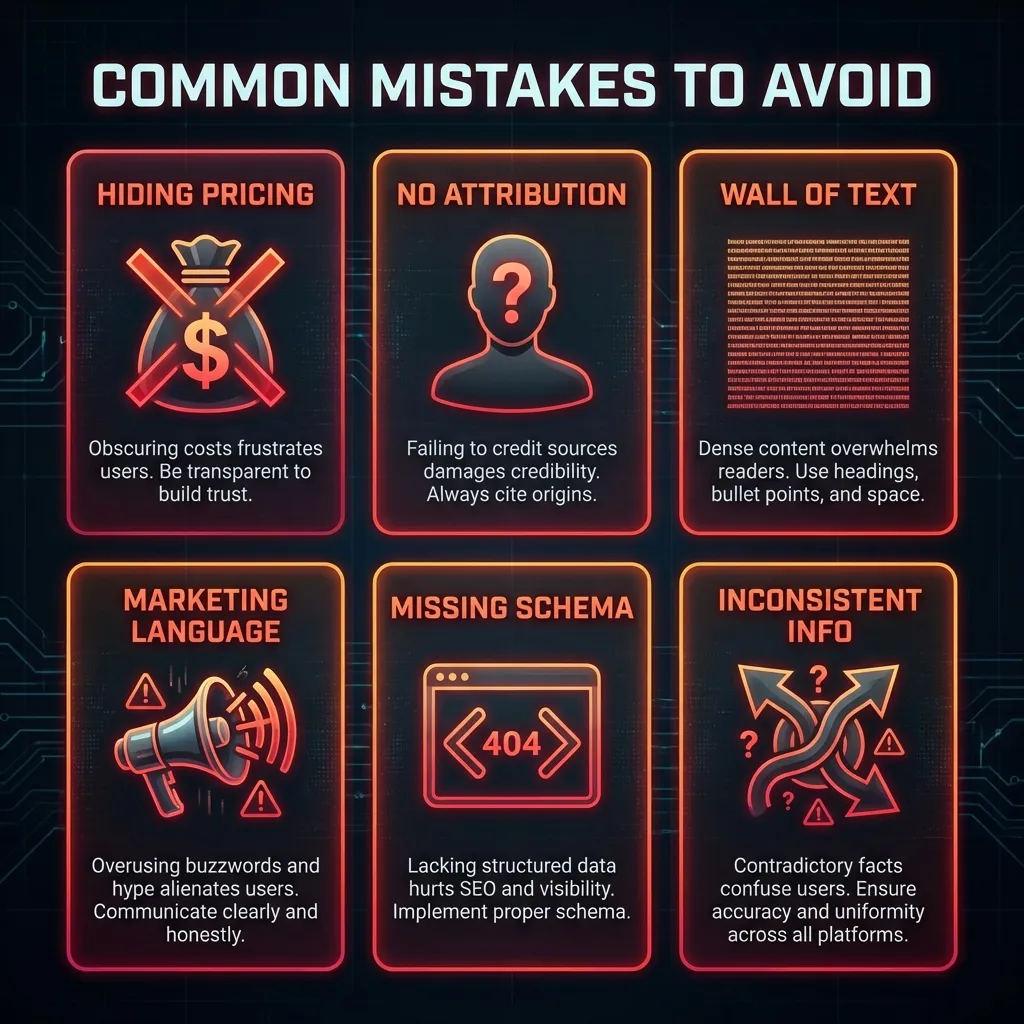
Marketing fluff
"Best-in-class," "revolutionary," "world-leading" - these provide no factual information for AI to cite.
Walls of text
Unstructured content without headings or paragraphs makes extraction impossible.
Anonymous content
Content without author attribution or company information lacks the trust signals AI requires.
Outdated content
Content without dates or with clearly outdated information is skipped for accuracy reasons.
Mistakes That Prevent AI Overview Inclusion
1. Burying the answer
Problem: Many pages delay the main answer to increase time on page.
Fix: Put the direct answer in the first paragraph.
2. Using vague hedging language
Problem: Vague hedging like "this might help" or "could potentially" is hard to quote.
Fix: Use precise, bounded claims. Example: "Studies show X improves Y by 20%" rather than "X might improve Y."
3. Missing schema markup
Problem: No structured data helps Google understand content type.
Fix: Add FAQ, HowTo, or Article schema as appropriate.
4. Inconsistent heading hierarchy
Problem: Jumping from H1 to H3 or using multiple H1s.
Fix: Use strict H1 → H2 → H3 hierarchy.
How to Optimize for AI Overviews
Follow this checklist to improve your chances of appearing in AI Overviews:
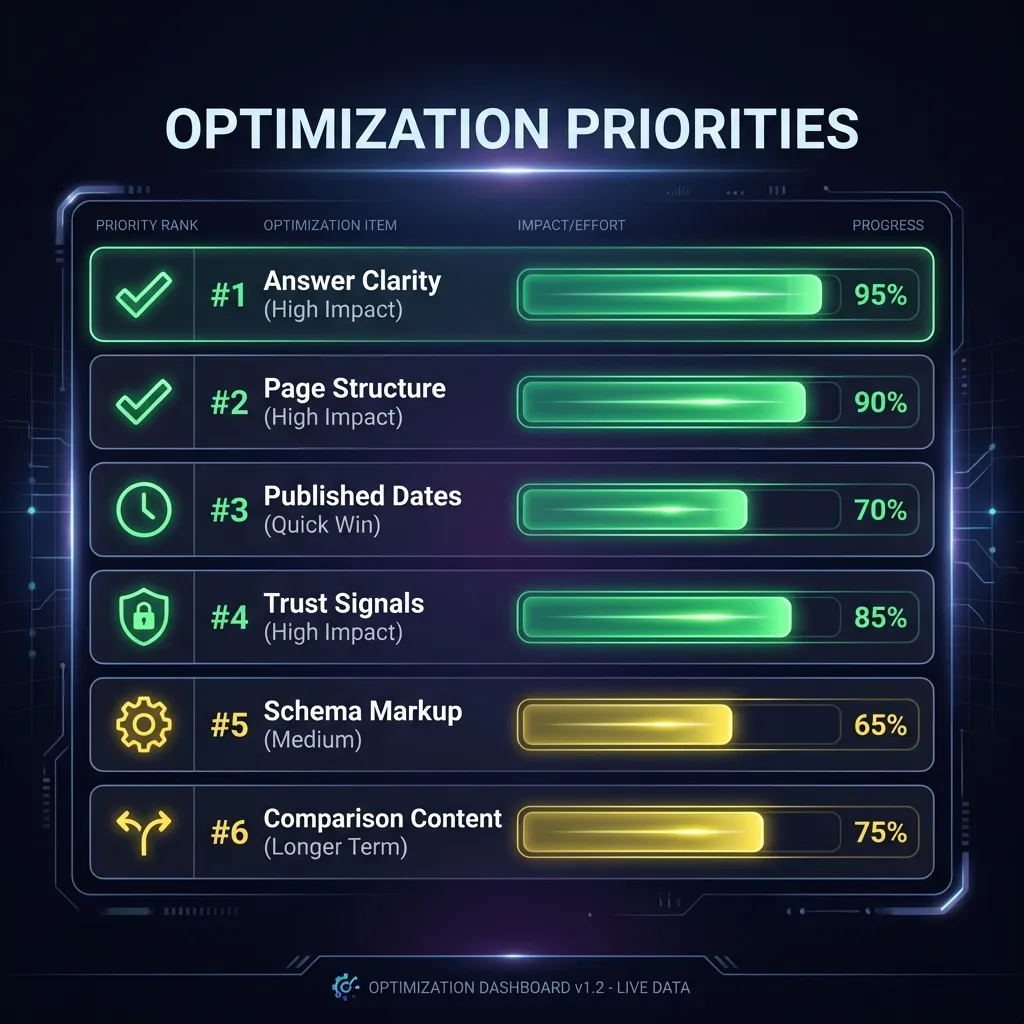
Page Structure
- One H1 that matches search intent
- H2s for each major section
- Short paragraphs (2-3 sentences)
- Bullet points for lists
- Tables for comparisons
Answer Clarity
- Direct answer in first paragraph
- Answer is under 50 words
- Uses factual language (not marketing)
- Can be quoted directly
- Precise claims (avoid vague hedging)
Trust Signals
- Author name on content
- Author credentials visible
- Published date displayed
- Updated date displayed
- Sources cited for claims
Sources and Documentation
Information about Google AI Overviews is based on official documentation and observed patterns:
- Google: AI Overviews in Search — Official Google announcement of AI Overviews
- Google: Creating Helpful Content — Content quality guidelines relevant to AI selection
- Google: About AI Overviews — User-facing documentation about how AI Overviews work
- Schema.org Getting Started — Structured data standards for machine-readable content
Frequently Asked Questions
Google AI Overviews are AI-generated summaries that appear at the top of certain search results. They synthesize information from multiple sources to provide direct answers to user queries.
To appear in AI Overviews, your content needs clear structure, direct answers in the first paragraph, proper headings, and trust signals like author names and dates. The content must be easily extractable by AI.
Not necessarily. AI Overviews select sources based on content clarity and extractability, not just rankings. A lower-ranking page with clearer answers may appear over the #1 result.
Currently, there's no official opt-out for AI Overviews. Google uses its discretion to include relevant content. Focus on whether appearing benefits your goals.
It depends. AI Overviews may reduce clicks for simple queries (users get the answer directly) but can increase visibility and authority for complex topics where users want to learn more.
AI Overviews appear for queries where Google determines an AI-generated summary would be helpful. This is more common for informational queries than navigational or transactional ones.
Related Resources
Your Site Passes Every SEO Audit. AI Still Ignores It.
83% of ChatGPT-retrieved pages aren't in Google SERPs. The 5 dimensions SEO audits miss.
Read moreBest Google AI Overviews Tools 2026
12 tools ranked for tracking and optimizing your AI Overview presence
Read moreHow to Get Into Google AI Overviews
Complete checklist for AI Overview optimization
Read more